by Maya Piotrowska and Bram de Jonge
The African Union Farmer Managed Seed Systems (FMSS) Policy Framework was presented and strongly supported by the Ministerial Seed Summit in Eswatini early October. The new framework, which aims to ‘enhance food and nutrition security through the recognition, protection and strengthening of farmer-managed seed systems in Africa’, is the first of its kind in the world. Together with the FMSS Strategy and Action Plan, the African Union spells out measures that aim to create an enabling environment, investments and partnerships for FMSS, while simultaneously protecting and conserving the continent’s invaluable plant genetic resources. It emphasizes the importance of aligning FMSS with formal seed systems for synergies and complementarity.
What happened?
Last week saw the Inaugural African Union Seed Summit take place in Eswatini, where hundreds of actors working on seed sector development from across the continent and beyond convened at the Ezulwini Palazzo from the 5th to the 7th of October 2026. Ministers, civil society, private sector, and development partners arrived in the lush landscapes of Eswatini, formerly known as Swaziland, for a three-day conference of plenary sessions and side events. Key items on the programme included the launch of the Seed Sector Performance Index (SSPI) Status Report for Africa (2025), the Revised 10-Year Africa Seed and Biotechnology Programme (ASBP) Action Plan, and the AU Farmer Managed Seed Systems (FMSS) Policy Framework.
The launch of the African Union FMSS Policy Framework marks one of the most significant policy milestones on the continent for inclusive seed sector development. Long overlooked and marginalised by policy, laws, and investments, the FMSS Policy Framework formally recognises the invaluable role that FMSS play in providing food and nutrition security, preserving agrobiodiversity, and serving as a source of climate resilience and adaptation. During its launch in plenary on the Monday afternoon, several country delegates provided a warm reception, with the Kenyan delegate stating that the FMSS initiative was ‘long overdue’, and ‘high time’ for the region to ‘consider reviewing policies, regulations, and legislation to support a system to compliment another’. The African Union Farmer Managed Seed Systems Policy Framework will formally be adopted during the next AU Heads of States Summit to take place early next year.
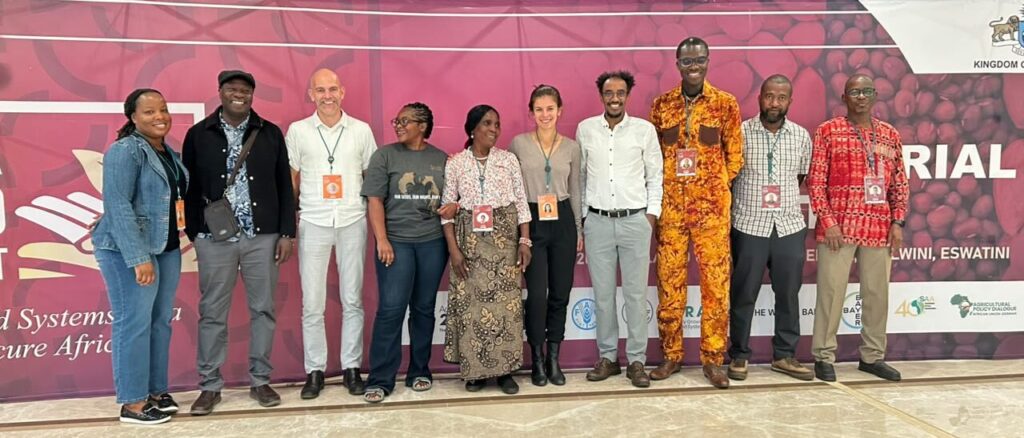
Gladness Brush Martin (SWISSAID), Daniel Wanjama (Seed Savers Network, Kenya), Bram de Jonge (Oxfam Novib), Mutinta Nketani (ZAAB), Joyce Mumba (Zambian farmer, SKI), Maya Piotrowska (Oxfam Novib), Kibrom Mehari (SWISSAID), Famara Diédhiou (AFSA), Fredrick Sanga (BCI), Mamadou Goïta (AFSA).
Although Oxfam applauds the AU member states for launching the Framework, its endorsement constitutes the first step in a journey that will require an earnest participatory process with diverse stakeholder representation for its implementation. Understanding of the ways in which FMSS operate remains fragmented, which could be observed in questions from some delegates citing their concerns that support for FMSS could hamper the private sector. The conference thus presented an opportunity for different factions working on seed systems to be brought together and demonstrate the importance of collaboration, plurality, and diversity in seeds and food systems.
- Oxfam’s publication ‘How support for farmer-managed seed systems paves the way towards resilient and diverse food systems in Africa’, outlines how support for FMSS can contribute to increased outcomes and international policy obligations, and key recommendations for their spport. The brief can be accessed by following this link.
- A collection of key resources from the CoP on how to support FMSS can be accessed here.
Promoting the exchange of diverse perspectives
Oxfam, alongside partner organisations and allies, participated as observers to monitor the draft texts being presented and interventions being made by country delegates, and to promote the adoption of the African Union Policy Framework on Farmer Managed Seed Systems. As part of the Community of Practice (CoP) for FMSS, Oxfam co-organised a side event ‘How to Implement the African Union’s Strategy Framework on Farmer-Managed Seed Systems?, alongside allies Seed & Knowledge Initiative (SKI), SWISSAID, AFSA, PELUM Uganda, CTDT Zambia, and ESAFF Uganda. The side event featured a rich series of presentations from leading practitioners with decades of grounded experience in Africa and aimed to promote and strengthen the dialogue on FMSS amongst stakeholders.
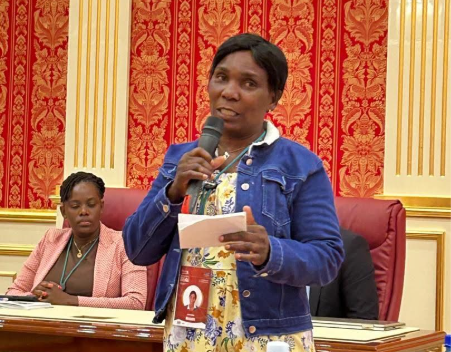
Fredrick Sanga (BCI Malawi) presented on progress in participatory plant breeding in Malawi and the role of community seed banks in reviving plant genetic resources and implementing Farmers’ Rights in practice. Joseph Mwitumwa (CTDT Zambia) and Joyce Muma (Zambian farmer) shared further insights on farmer-led participatory research in collaboration with the Zambian Agricultural Research Institute and the subsequent varieties developed, registered, and being multiplied by farmers at community seed banks. Jude Ssebuliba (PELUM Uganda) presented findings from a recent study in Uganda on decentralised quality assurance methods and policy recommendations and guidance for policymakers. This was followed by a lively panel discussion featuring Dr Lloyd Mbulwe, Acting Chief Agriculture Research Officer for Crop Improvement and Agronomy, Zambia; Dr Modester Kachapila, Head of the Malawi Plant Genetic Resources Centre, Department of Agriculture Research Services, Malawi; Famara Diédhiou, AFSA Programme Coordinator for West Africa; and Stella Rose Akutui, ESAFF Uganda Programme Officer Policy and Research.
A focus case study on the recent High Court decision in Kenya examined how judicial bodies are increasingly drawing on international human rights instruments—particularly the UN Declaration on the Rights of Peasants and Other People Working in Rural Areas (UNDROP)—to affirm and protect the right to seed. It also highlighted how civil society organizations and farmers’ groups are responding by strengthening their organizational and legal capacity and building strategic alliances, presented by the Executive Director of Seed Savers Kenya, Daniel Wanjama, and Joan Kembabazi, Programme Head Social Justice & Strategic Litigation at CEFROHT Uganda.
Approximately 70 participants attended, including civil society, government stakeholders and farmers, and engaged in animated discussion on topics such as access and benefit-sharing and farmer variety registration, for example on how to balance simplification of procedures for variety registration and quality control with the needs of both seed certification authorities and farming communities. The points raised demonstrated the need for sustained engagement and dialogue between stakeholders, and above all, for adequate representation of farmers and their communities to be able to meaningfully participate in policy decisions that impact them most acutely. The session concluded with a keynote speech from Mamadou Goïta, a member of AFSA and IPES-Food, which emphasised that Africa’s seeds are sovereign, and their future governance must be rooted in principles of justice, biodiversity, democracy and Farmers’ Rights, as well as the necessary recognition of the role of women farmers as the custodians of biodiversity.
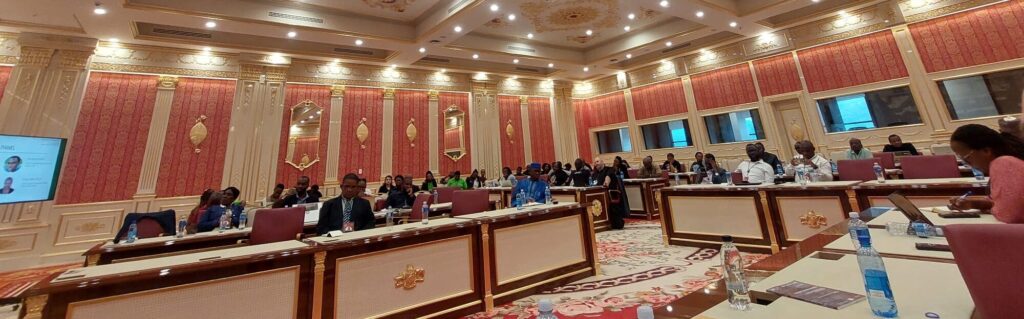
Photo of the side event at the Ezulwini Conference Centre.